Showing posts with label Buffalo Trace. Show all posts

Friday, November 23, 2012

Thanksgiving Pie Fight

It was the last card on a long day. Naps were over, dishes were done. Time for a last piece of pie. Oh... maybe a thin slice of that Pecan.

Oh, and for a last nip to close the evening. Whatllyahave? The early thought was Zaya aged rum, but that seemed too safe and easy and then the decision was Rye or Bourbon and why the hell not, bring out the George T Stagg. And the battle was on!

A little background.

A hundred and fifty years ago legendary Kentucky distiller E.H. Taylor partnered with distiller/financial wizard George T Stagg to build the state-of-the-art distillery of its day, known for many years as the George T Stagg distillery. It was one of only a handful to survive Prohibition and is known today as Buffalo Trace. Every year Buffalo Trace chooses a handful of old barrels of the most powerful aged bourbon they can find and bottle it uncut and release it under the George T Stagg label as part of their "Antique Collection."

Up until a few years ago these bottles sat in dusty lockboxes with other rare old whiskies and waited for the rare collector to show up and claim their prize. Today they are fought over tooth and nail. At the store, we have over a hundred names on the waiting lists for the meager allocation of bottles we will receive. More customers are hurt and angry than are made happy. The sad thing is that there are more great American whiskies on the shelf than ever before, but no one wants to buy goods off the rack.

But come on, it's not about the whisky it's about the coup. Pappy Van Winkle. Buffalo Trace Antique Collection for the new cognoscenti. Jeez, Amerika! Are we drinking whisky or collecting baseball cards?

Ok. Deep breath. Rant over. Eat pie, Drink whiskey. Calm down.

The pie is delicious. Rich, sweet and nutty, Susan adds a layer of broken pecan pieces which float to rest just under the decorative top layer of arranged Fancy Jumbo Halves for extra pecan nuttiness.

However, as delicious as the pie may be, the first sips of the Stagg blow the pie clean off the palate like a flamethrower with its hot, stinging breath of alcohol (70.9%) and massive flavors. But curiously, as I eat more of the pie, it offers more and more resistance to the whiskey. Creamy layers of dark, nutty candy coat the tongue until finally balance is achieved and the flavors merge with the sweet cinnamon tobacco richness of the whiskey in some form of Southern Nirvana.

Happy Thanksgiving.

Thursday, March 15, 2012

Single Oak Redux

You knew there might be more of these...


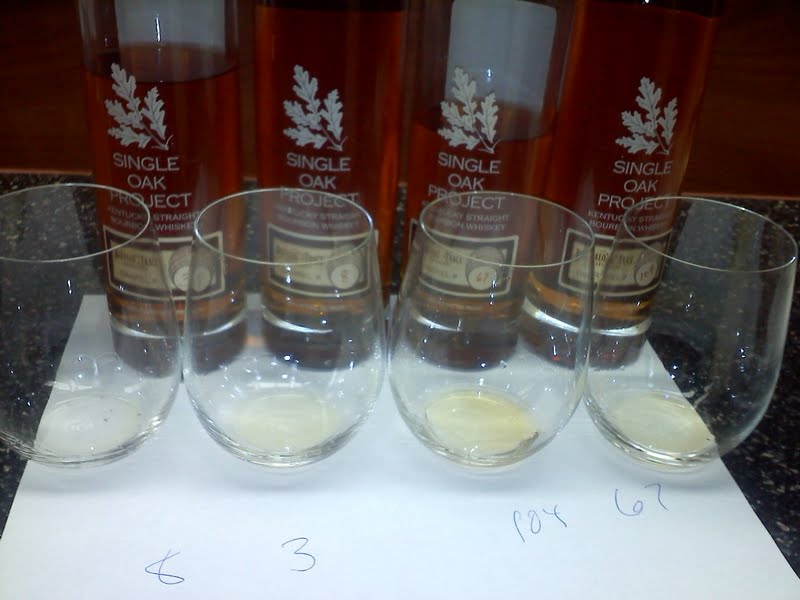
Joined up this evening with the Reverend Doctor to share tastes of the third release of Buffalo Trace's Single Oak Project. And while we were at it, we revisited a couple of other releases along with Eagle Rare 10 and 17 (Buffalo Trace Rye Recipe) and a recent release of Pappy Van Winkle's 12 year Lot B. I think I was able to keep it all straight.


We started with the Eagle Rare 10 yr old to gear the senses for the upcoming onslaught of strong spirits. And it was quite nice. Spicy cinnamon and burnt oranges, honey and caramel, round, smooth and spicy, with a lot of earthy vanilla. All typical notes for rye recipe bourbon.


As it turns out, it set a strong pattern for three of the Single Oak bourbons. Bottles 3, 8 and 67 were all rye, with 125 entry proof. They were all very similar. In fact they showed the same flavor descriptors as the Eagle 10 with nuanced differences between the three. But the quality was much higher than the 10. The texture was totally different and the brilliant flavors shifted like a kaleidoscope as the thick luxurious liquid rolled around the tongue. 


To the differences. Barrels 3 and 67 were very similar flavors, 3 was lighter, 67 was buttery. Barrel 8 was very similiar, but had a distinct earthiness. When I compare the facts on the Single Oak website, all three bourbons are virtually identical, distilled on the same day from the same recipe. Barrels 2 and 3 were made with wood from the tops of the tree with a slight variation in tightness of grain. Both were aged on the 7th floor of the same concrete floored warehouse. Barrel 8  was made from the bottom of the tree and was aged on the 3rd floor of a wooden warehouse.  Yikes, a difference in barrel and a difference in flavor. Was one better? I think it's up to the taster.

On the Single Oak website, there's a video shot in the Ozark forest as these trees were being felled. It's fascinating to hear Ronnie Eddins talk about how the sugar level is affected by grain, growth rate of the tree, and whether the tree was grown on the top of a hill, in a valley, or on a hillside. Of course the sugar level of the wood affects the caramelization of the barrel and thus the terroir of the barrel has great affect on the final whiskey.


Barrel 104 on the other hand was totally different. And the only difference was the recipe. The flavoring grain was wheat. The whiskey was dry and elegant with notes of grass, honey and smoke and a hint of anise. I have also tasted Barrel 36 which is wheated. My notes show a sweeter whiskey with more vanilla and hints of fruit. Again, the bourbons are identical in DNA except that 104 was aged in a concrete floor warehouse and the 36 was in wood.


Now to the ringers. The Pappy 12 year has slightly darker color and definitely has a sweeter finish and more burnished citrus fruits than the 104.  But it is definitely finished with wheat and not rye, and it is 4  years older than the 8 year old Single Oaks.


The age of the Eagle Rare 17 is a definite trump. Oh, my it's silky. Big wood sits down with a thump of vanilla. And then the same rye flavors begin creaping out around the edges and hanging on through the long finish.


I'm exhausted. That was a lot of really good whiskey to keep track of, and the similarity of most of whiskeys made it even more difficult. Overall, there were differences were age and recipe. Wheat vs rye. 8 vs 10 vs 12 vs 17. Nuanced differences based on warehousing and grain. The most notable difference of all was between the Eagle 10 and every other whiskey. They were just on a different level of quality.

Monday, August 22, 2011

Buffalo Trace Single Oak Project

It's the one of the geekiest marketing schemes I've experienced.

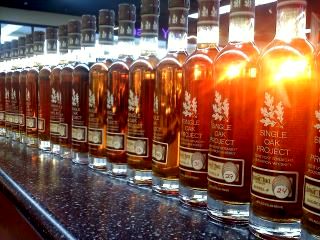
Choose 96 white oak trees. Cut barrel staves out of the top of the tree and out of the bottom. Vary the seasoning. So, 2 two barrels times 96 trees equals 192 barrels. Make 4 recipes of bourbon, 2 with rye, 2 with wheat, vary the entry proof and the aging regimen for a total of 7 variables. 192 barrels. Then bottle and release 12 barrels every four months. That's half bottles (375 ml) for between $55 and $89 according to my latest Google search. What!!!!

Scam or serious?

Buffalo Trace says they want to find the 'perfect' or 'favorite' bourbon. Purchasers are invited to log on to the Single Oak Project home page and register their own tasting notes in a structured format. Even better, the tasters can find out all the particulars down to the last nitty gritty about their particular bottle. And see other tasters and compare notes. At the end of the Project, when all the barrels have been released, Buffalo Trace will have amassed an enormous amount of data. They say they will put the favorite into production!

They sound serious. The bottles are all hand wrapped and hand numbered. The bottles are expensive, but so are the production values. I guess that it ultimately comes down to the whiskey.

I chose a bottle from barrel 67.

Why? Because I did my Internet homework and knew that it was a high-rye recipe from a barrel from the top of an average grained white oak tree. I like high-rye bourbons. And according to what I read, barrels of coarse-grained oak from the bottom of the tree and the MOST effect on the whiskey. Conversely barrels from fine-grained oak from the top of the tree have the LEAST effect on the whiskey. So my whiskey should have some, but not a lot of oakiness.

And how was the whiskey?

Delicious! Rich golden amber in color. Aromas of vanilla, butterscotch, burnt spiced orange peel and delicious whiskey waft langorously. Texture is heavy, rich and unctuous. Flavors of orange, cinnamon, caramel  roll over the tongue and coat the mouth with butterscotch and bright little suggestions of anise. Finish is long. Luxurious whiskey. Lets the taster know that life ain't all bad!

There is the possibility of a small Single Oak Project community fueled by the Project web-site, ebay, word of mouth and an ever increasing number of whiskey drinkers with blogs praising some barrels and damning others. I hope the experience of all those who succumb to the geekiness have as rewarding experience as I did. If they do, the rest of the project will be presold and fought over. If not....